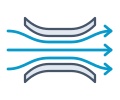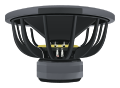
Ported box.
Simulate complex cone and port output, cone excursion, and electrical impedance. Around tuning, the port does more of the work. Below tuning, check the cone.

Driver parameters
Enclosure design
Port geometry
Drive & radiation
Blank uses the cone listening distance. Different paths are summed as complex pressures.
Optional acoustic losses
Leave blank for an ideal lossless port.
Leave blank for no absorption resistance.
Leave blank for an airtight chamber.
Air & conventions
Frequency sweep
Acoustic response
LOG FREQUENCYDriver excursion reaches 37.27 mm, exceeding the 12.50 mm one-way limit within this sweep. Reduce drive or evaluate protection.
Below tuning, cone excursion can rise rapidly. This small-signal estimate does not model heating, turbulence, or nonlinear driver behavior.
Read this result with its assumptions.
Sweep: 10-200 Hz, 241 logarithmic samples. Maxima describe this sampled range, not an unrestricted operating limit.
SPL is at 1 m in ideal half-space. Electrical drive is RMS; displayed excursions and air velocities are one-way peak.
Units & assumptionsYour calculations run in this browser. No account needed.
The math, in plain sight.
Look beyond a tuning frequency.
Build the driver and vent model
The full model uses RMS voltage drive and complex acoustic impedances. Driver parameters are derived from their small-signal relationships, with all quantities converted to SI units first.
Explicit absorption and leakage model
Leaving Qa or Ql blank removes the corresponding loss. The ideal model uses Ra = 0 and infinite Rl. A modeled leak loss is not automatically an accurately modeled additional sound radiator. The default finite port Q is explicitly shown in the input form.
Cone motion and port output
The negative chamber-pressure sign is intentional: port and cone output tend to cancel at sufficiently low frequency. The amplifier sees the displayed driver input impedance plus the external series resistance. Separate contribution curves must not be added in decibels.
Ideal normalized response check
This lossless, low-inductance expression is normalized to its ideal upper passband. The calculator uses the full complex model for output, cone motion, losses, and impedance.
Around tuning, port output can be large while cone excursion falls. Below tuning, cone excursion can rise rapidly. Check operating voltage and high-pass protection, not just the tuning frequency.