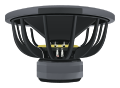
Enclosure volume.
An enclosure is described by its net acoustic volume, not its outside dimensions. Find the internal volume and see every deduction before you build.

Cabinet dimensions
Individual panel overrides
Blank uses the default thickness.
Blank uses the default thickness.
Blank uses the default thickness.
Blank uses the default thickness.
Blank uses the default thickness.
Blank uses the default thickness.
Internal deductions
Include the duct air and material inside the cabinet. Do not count a shared cabinet wall twice.
Every subtraction, accounted for
| Component | Volume (L) |
|---|---|
| Gross internal volume | 53.033 |
| Driver | - 3.000 |
| Braces | - 1.500 |
| Electronics & hardware | - 0.800 |
| Internal port | - 2.850 |
| Net acoustic volume | 44.883 |
Read this result with its assumptions.
Inside dimensions: 464.0 x 364.0 x 314.0 mm.
Use the net volume in your enclosure model. Include internal duct air and material in port displacement, without subtracting a shared wall twice.
Units & assumptionsYour calculations run in this browser. No account needed.
The math, in plain sight.
Count the space the air actually has.
The space the air actually has
Net acoustic volume is the air available after subtracting drivers, internal ducts, braces, and equipment. It is not the external volume or the unoccupied internal volume. For rectangular cabinets with unequal opposing panels:
Account for the whole internal duct
A round duct occupies its external cross-section multiplied by its length inside the cabinet. For a rectangular duct, use its external occupied cross-section. The air inside the duct belongs to the duct, not the free chamber. Do not subtract a cabinet wall twice when it also forms a slot-port wall.
Worked example
A 500 x 400 x 350 mm cabinet with 18 mm panels has internal dimensions of 464 x 364 x 314 mm. Its gross internal volume is 53.03 L. Subtract 3.0 L for the driver, 1.5 L for braces, 0.8 L for electronics, and 2.85 L for the internal duct.
Use 44.88 L, not 53.03 L, in the enclosure model. A changed port length also changes displacement, so a compact ported design may need another calculation pass.