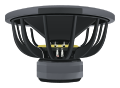
Passive radiator.
A passive radiator can solve a port-length problem, but it has its own compliance and excursion limit. Calculate the required mass per radiator, then inspect the coupled system.

Enclosure design
Radiator parameters
Model selection
Driver parameters
Drive & radiation
Air & conventions
Frequency sweep
Acoustic response
LOG FREQUENCYDriver excursion reaches 29.49 mm, exceeding the 12.50 mm one-way limit within this sweep. Reduce drive or evaluate protection.
Radiator excursion exceeds its 20.00 mm one-way limit within this sweep.
Read this result with its assumptions.
Sweep: 10-200 Hz, 241 logarithmic samples. Maxima describe this sampled range, not an unrestricted operating limit.
SPL is at 1 m in ideal half-space. Electrical drive is RMS; displayed excursions and air velocities are one-way peak.
Units & assumptionsYour calculations run in this browser. No account needed.
The math, in plain sight.
Tune the mass. Check the movement.
Find the target mass per radiator
A radiator replaces vent air mass with a diaphragm and suspension. Its own compliance must be included. N is the number of identical radiators; every reported mass is per radiator.
If added mass is negative, adding weight cannot reach the requested tuning. A lighter radiator or a different design is required.
Check the coupled response
Active-driver properties are derived as in the Thiele-Small parameter calculator. Compare the radiator excursion with its own one-way rating, not the driver rating.
Worked example and verification
One radiator in 40 L, with Vas,pr = 100 L, area 400 cm2, and target tuning 25 Hz, needs an ideal target moving mass of about 320 g. An existing 200 g radiator therefore needs about 120 g added.
The radiator free-air resonance can create a low-frequency dip. Losses and mounting-dependent air mass also change real tuning. Verify the finished cabinet by measurement.


